Fridge running warm or not cooling
Usually a dirty condenser coil, failing evaporator fan, or a stuck damper. We check airflow and temperature in both compartments before recommending any parts.
• URGENT
A warm fridge rarely waits. Our Round Rock technicians diagnose cooling loss, ice maker issues, leaks, and compressor and fan faults, then walk you through a practical fix before any work begins.
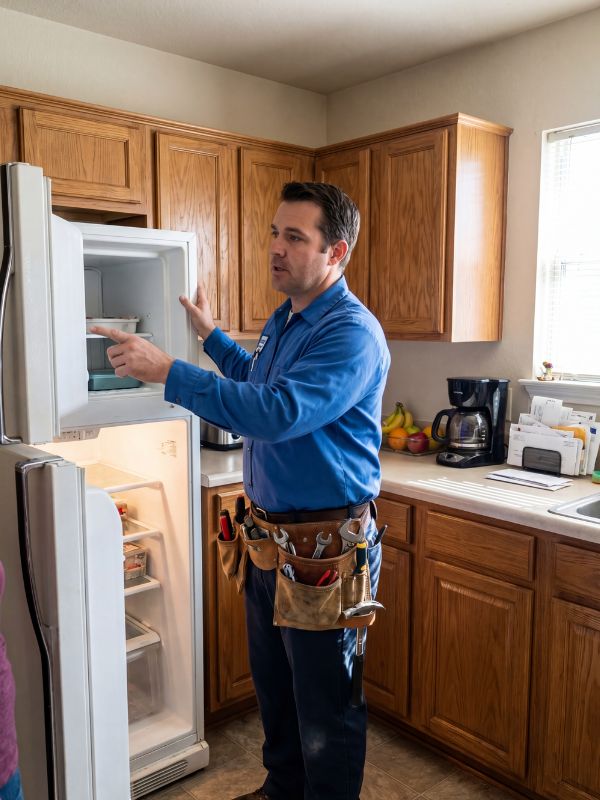
These are the refrigerator problems we see most often in Round Rock homes, and the kind of thing we repair in a single visit.
Usually a dirty condenser coil, failing evaporator fan, or a stuck damper. We check airflow and temperature in both compartments before recommending any parts.
Classic evaporator fan or damper fault. Cold air isn't circulating into the fresh-food compartment. A common same-visit fix on French door and side-by-side units.
Usually a clogged defrost drain, a cracked water line, or a loose fitting on the ice maker inlet. We trace the source first so you only pay for the real repair.
Could be a frozen water line, a failed inlet valve, or a dead ice maker module. We test each link in the chain, cheapest fixes first.
Defrost heater, defrost thermostat, or control board is failing to run the defrost cycle. We test the circuit and replace only what's actually bad.
Compressor relay, a failing condenser fan, or loose components behind the panel. We identify the sound source and quote the fix before doing any work.
Every brand codes things differently. Tell us what the panel says when you call and we'll arrive ready with the likely parts on the truck.
Worn gasket, sagging hinge, or an overloaded door bin. We replace seals and realign doors so the fridge stops running nonstop.
Often a clogged defrost drain holding old water. We clean the drain path and check the gasket for hidden spoilage trapped in the folds.
Throwing parts at a refrigerator until something works is how repair bills get out of hand. Here's the structured order we follow on site.
Freezer cold and fridge warm points to airflow or damper issues. Both warm with the compressor running points to defrost or refrigerant. Both warm with the compressor not running points to a control circuit or compressor fault. We log temperatures with a calibrated probe rather than trusting the panel.
The evap fan sits behind the freezer back wall and circulates cold air. Verifying it spins freely, draws normal current, and runs at correct speed catches a huge percentage of "running but not cooling" calls. Roughly a 30-minute swap once the panel is off.
The condenser dumps heat from the refrigerant. In Round Rock kitchens with pets, it packs with hair faster than homeowners realize. A blocked condenser forces the compressor to overwork. Cleaning is included on most diagnostic visits.
On units where freezer airflow reaches the fresh-food side through a damper, we verify the damper opens, closes, and isn't blocked by debris or ice. Stuck dampers commonly mimic a failed evaporator fan and cost much less to fix.
Three parts can fail: heater, defrost thermostat, and control board. We test continuity on the heater first, then the thermostat, then the board last. Each costs differently — the diagnostic order avoids the expensive guess.
When the compressor isn't starting, the relay and start capacitor are the usual suspects — far more often than the compressor itself. We bench-test both with a multimeter and measure motor windings before recommending the bigger repair.
When we quote a refrigerator repair, here's what's behind each part name and why it matters for the cost and timeline.
Pull the freezer back panel, disconnect the harness, swap the motor (and blade if worn). 30–45 minutes on most platforms. Restores cold-air circulation to the fresh-food compartment.
Accessed from the back or bottom depending on the platform. When it fails, compressor temperature rises and cooling drops across both compartments. Tighter access on built-ins, but mechanically simple.
Heater, thermostat, or control board depending on which component failed. Heater swap is the longest of the three; thermostat and board swaps are faster. Diagnostic determines which part actually needs replacing.
A worn gasket lets warm humid air into the cabinet, runs the compressor harder, and can cause frost buildup. Strip-and-reseat job that adds years of service life on a unit with a healthy compressor.
The valve sits at the back where the water line connects. When it fails — usually scaled shut on hard-water systems — water stops reaching the ice maker and dispenser. Pull the back panel, swap the valve, verify flow.
The module is the brains and motor of the ice maker. When it fails, the rest of the chain may be fine. Unit swap rather than component repair: pull old, install new, restore power and water, run a test cycle.
Honest math, not a sales pitch. The four variables that decide whether a repair earns its cost.
Our technicians are trained across the full lineup. If it's a major household brand, we've probably fixed one.
If yours isn't listed, just ask. We service many more.
Each style has its own diagnostic patterns, parts, and repair-vs-replace economics.
Tell us what your refrigerator is doing. We'll confirm a same-day or next-day window with real ETAs, not 4-hour ranges.
A local technician arrives, diagnoses the issue, and gives you a flat repair quote before any work begins.
We finish the fix on the first visit when possible, then back every refrigerator repair with a 90-day workmanship guarantee.
These can either save you a service call or narrow what we should bring on the truck.
Plug a known-working device into the same outlet. Check the breaker panel and any GFCI upstream. A surprising number of "dead fridge" calls turn out to be a tripped breaker or GFCI.
Internal panels and dial controls drift, get bumped, or get adjusted by kids. Confirm freezer at 0°F and fridge at 37–40°F. If they're way off, set them back and give the unit eight hours.
If you can see the coil from the back or lower front grille, vacuuming the dust off is the highest-value DIY task. On units in place for a few years, this alone can resolve "running constantly" complaints. Unplug first.
With the unit running, listen at the back for the condenser fan moving air. Inside, with the freezer door closed, you should feel the evaporator fan circulating cold air. Silence on either side is diagnostic.
If the compressor isn't starting, repeated power cycling can damage the start relay and overload protector. One restart is fine. Three or four in a row makes things worse. Leave it off and call.
Most modern fridges show a code on the panel when something's wrong. Tell us the code when you call — we can pre-load the most likely parts on the truck before we leave the shop, which often turns a two-visit repair into a one-visit one.
No vague windows. No surprise invoices. Just clear communication and clean work in your home.
Call, text, or book online. We confirm a realistic time window and show up within it.
Flat diagnostic fee up front and a clear repair quote before any work begins.
Experienced with every major household appliance brand. In uniform, on time.
Evening and weekend windows are available for busy Round Rock households.
We live and work in the Round Rock area. Your neighbors are our customers.
Shoe covers, tidy workspace, tools kept out of reach of kids and pets.
A refrigerator drifting warm in late June in Round Rock is a different conversation than the same fridge in November. Heat load on the sealed system is higher, the condenser is working harder against ambient temperatures, and the gap between “running fine” and “losing food” can collapse to a few hours. What follows is how we approach the diagnostic, the repair paths we see most often, and the honest cases where repair stops making sense and replacement starts.
Two local conditions shape most of the refrigerator calls we get. The first is water hardness — Round Rock water is moderately hard, which means ice maker inlet valves, water filters, and ice mold passages scale up faster than in softer-water regions. Combined with high summer cycle counts from family entertaining, ice makers here tend to fail in a predictable order: filter restriction first, then inlet valve, then the ice maker module itself.
The second is garage temperatures. Round Rock summers regularly push uninsulated garages past 100°F, and standard refrigerators aren’t rated for those ambient conditions. If a garage fridge is running constantly or failing early, it’s usually not defective — it’s the wrong tool for the conditions. Garage-rated models exist for a reason.
For the most common single refrigerator complaint, we’ve written a longer walk-through at Why is my refrigerator not cooling? covering the diagnostic order in homeowner-readable language. If the call is about a freezer or ice maker specifically, see Freezer Repair and Ice Maker Repair for those platforms.
Our vans cover Williamson and north Travis counties every day. If you're nearby, we're likely 30 minutes away.
Call now and talk to a real person, or send us a few details and we'll get back within the hour during business hours.